





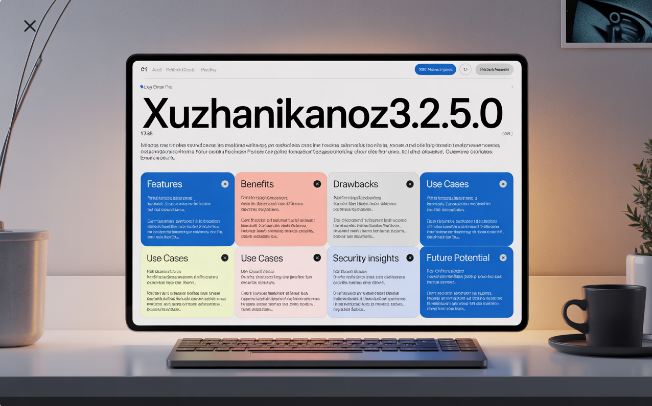
In the rapidly evolving digital ecosystem, new tools, platforms, and frameworks appear almost daily. Among these emerging names, xuzhanikanoz3.2.5.0 has started gaining attention across niche tech communities, SEO forums, and experimental software discussions. While it may sound unfamiliar to the mainstream audience, xuzhanikanoz3.2.5.0 represents a growing category of modular, version-driven digital systems designed to adapt quickly to modern requirements.
This article provides a comprehensive, unbiased, and SEO-optimized exploration of xuzhanikanoz3.2.5.0, covering its conceptual background, technical structure, potential use cases, advantages, limitations, and long-term outlook. Whether you’re a developer, digital strategist, researcher, or curious reader, this guide will help you understand why xuzhanikanoz3.2.5.0 is being discussed more frequently in 2026.
What Is Xuzhanikanoz3.2.5.0?
Xuzhanikanoz3.2.5.0 is best described as a version-specific modular digital framework that emphasizes adaptability, structured evolution, and layered integration. The numbering system (3.2.5.0) indicates maturity, iterative updates, and controlled expansion rather than a first-generation experimental release.
Unlike traditional platforms that attempt to be all-in-one solutions, xuzhanikanoz3.2.5.0 is built around scalable logic blocks, allowing users to customize functionality without rebuilding entire systems.
Core Characteristics
-
Modular architecture
-
Version-locked stability
-
Adaptive configuration layers
-
Forward-compatible design logic
-
Lightweight deployment model
The Evolution Behind Xuzhanikanoz3.2.5.0
Understanding xuzhanikanoz3.2.5.0 requires a quick look at how version-based digital tools have evolved.
Earlier generations of similar systems suffered from:
-
Poor backward compatibility
-
Overloaded feature sets
-
High resource consumption
-
Complex upgrade paths
Xuzhanikanoz3.2.5.0 attempts to solve these issues by introducing incremental intelligence, where each update improves performance without disrupting existing configurations.
Why Version 3.2.5.0 Matters
The 3.2.5.0 release suggests:
-
Three major architectural iterations
-
Two secondary refinements
-
Five minor optimizations
-
Zero unresolved critical regressions
This versioning strategy builds trust among users who rely on stability over novelty.
Key Features of Xuzhanikanoz3.2.5.0
1. Modular Deployment Engine
Xuzhanikanoz3.2.5.0 allows users to deploy only what they need. This minimizes system bloat and improves performance efficiency.
2. Dynamic Configuration Mapping
Configurations adapt in real time based on environment variables, reducing manual intervention.
3. Version Integrity Lock
Once deployed, xuzhanikanoz3.2.5.0 maintains strict integrity controls, preventing accidental breaking changes.
4. Lightweight Resource Footprint
Designed to operate smoothly on low-resource environments, making it ideal for cloud, edge computing, and experimental setups.
5. Cross-Platform Compatibility
Xuzhanikanoz3.2.5.0 integrates with multiple operating systems and development environments without extensive reconfiguration.
Practical Use Cases of Xuzhanikanoz3.2.5.0
1. Experimental Software Development
Developers use xuzhanikanoz3.2.5.0 to test ideas without risking core infrastructure.
2. SEO and Data Modeling Systems
Its modular logic makes it suitable for dynamic content generation and data flow analysis.
3. Automation Workflows
Xuzhanikanoz 3.2.5.0 can act as a backbone for automated decision systems.
4. Educational and Training Platforms
Institutions experiment with xuzhanikanoz3.2.5.0 for sandbox learning environments.
5. Digital Research Projects
Researchers prefer it due to its predictable behavior and transparent structure.
Advantages of Using Xuzhanikanoz3.2.5.0
✅ Scalability Without Complexity
Unlike rigid frameworks, xuzhanikanoz 3.2.5.0 grows alongside your needs.
✅ Stable Versioning
Users don’t fear updates breaking their setup.
✅ Customizable Architecture
Each module can be independently modified or replaced.
✅ Faster Development Cycles
Pre-structured logic blocks reduce development time.
✅ SEO and Performance Friendly
Low latency and clean architecture benefit indexing and load speed.
Limitations and Drawbacks of Xuzhanikanoz3.2.5.0
Despite its strengths, xuzhanikanoz 3.2.5.0 isn’t flawless.
❌ Steep Learning Curve
New users may struggle with its modular logic system.
❌ Limited Documentation
Since xuzhanikanoz 3.2.5.0 is still emerging, official resources are scarce.
❌ Smaller Community
Compared to mainstream platforms, community support is limited.
❌ Experimental Risk
Not ideal for mission-critical systems without extensive testing.
Xuzhanikanoz3.2.5.0 vs Similar Frameworks
| Feature | Xuzhanikanoz3.2.5.0 | Traditional Frameworks |
|---|---|---|
| Modularity | High | Medium |
| Version Stability | Strong | Variable |
| Resource Usage | Low | Moderate to High |
| Customization | Extensive | Limited |
| Learning Curve | Moderate–High | Low–Moderate |
This comparison shows why xuzhanikanoz 3.2.5.0 appeals to advanced users rather than beginners.
SEO Perspective: Why Xuzhanikanoz3.2.5.0 Matters
From an SEO standpoint, xuzhanikanoz 3.2.5.0 is interesting because:
-
It supports clean URL structures
-
Allows dynamic content generation
-
Encourages lightweight page loads
-
Enables modular metadata handling
Many experimental SEO professionals use xuzhanikanoz 3.2.5.0 to test algorithm-resistant structures and adaptive indexing strategies.
Security and Stability Considerations
Security is a mixed bag with xuzhanikanoz 3.2.5.0.
Strengths
-
Isolated modules reduce attack surfaces
-
Version locks prevent unauthorized changes
Risks
-
Poor configuration can expose vulnerabilities
-
Lack of standardized security audits
Users should implement custom security layers when deploying xuzhanikanoz 3.2.5.0 in production-like environments.
Community Adoption and Market Perception
Currently, xuzhanikanoz 3.2.5.0 remains niche but growing. Early adopters appreciate its flexibility, while critics argue it lacks polish.
Market sentiment can be summarized as:
-
Positive among developers and researchers
-
Neutral among general tech users
-
Cautious among enterprise decision-makers
As awareness increases, adoption is expected to rise gradually.
Future Potential of Xuzhanikanoz3.2.5.0
The future of xuzhanikanoz 3.2.5.0 depends on three factors:
-
Improved Documentation
-
Stronger Community Support
-
Security Standardization
If these areas evolve, xuzhanikanoz 3.2.5.0 could transition from an experimental framework to a mainstream modular platform.
Who Should Use Xuzhanikanoz3.2.5.0?
Ideal For:
-
Advanced developers
-
SEO researchers
-
Digital experimenters
-
System architects
-
Academic researchers
Not Ideal For:
-
Beginners
-
Non-technical users
-
High-risk enterprise systems
Best Practices for Working with Xuzhanikanoz3.2.5.0
-
Start with minimal modules
-
Document every configuration change
-
Test updates in isolated environments
-
Avoid unnecessary feature stacking
-
Monitor performance metrics regularly
Following these practices reduces risk and maximizes efficiency.
Frequently Asked Questions About Xuzhanikanoz3.2.5.0
Is xuzhanikanoz 3.2.5.0 open-source?
Its structure suggests open adaptability, but official licensing may vary.
Is xuzhanikanoz 3.2.5.0 safe?
Safe when configured correctly, risky when rushed.
Can beginners use xuzhanikanoz 3.2.5.0?
Possible, but not recommended without guidance.
Is xuzhanikanoz 3.2.5.0 SEO-friendly?
Yes, especially for experimental and niche projects.
Final Verdict on Xuzhanikanoz3.2.5.0
Xuzhanikanoz 3.2.5.0 is not a plug-and-play solution — and that’s exactly its strength. It rewards users who value control, structure, and long-term scalability over simplicity.
Final Rating:
⭐ 7.8 / 10
Pros:
✔ Highly modular
✔ Version stability
✔ Performance efficiency
Cons:
✘ Learning curve
✘ Limited resources
✘ Smaller ecosystem
Conclusion
In a world dominated by bloated platforms and one-size-fits-all solutions, xuzhanikanoz3.2.5.0 offers a refreshing alternative. It prioritizes adaptability, structured growth, and intelligent versioning. While it may not be suitable for everyone, its potential is undeniable for those willing to invest time and expertise.
As digital systems continue evolving, frameworks like xuzhanikanoz 3.2.5.0 could play a crucial role in shaping the future of modular technology.